
Attendance
Inclusive attendance
Coming to school regularly helps children learn, build friendships and feel part of school life.
Our Lady’s is an Inclusive Attendance school. Our approach puts children’s needs, relationships and a sense of belonging at the centre of our work with families.
If getting to school is difficult, please talk to us early so we can understand what is happening and find the right support.
Report an absence
Please telephone the school office by 9:15am on each day your child is absent. You can leave a message on the answerphone.
Call 0121 464 4459Give your child’s name, class and the reason for their absence.
We follow up unexplained absence to check that children are safe. Please keep your contact details and emergency contact numbers up to date.
Arriving on time
- Children can enter
- 8:35am
- School starts
- 8:40am
- Morning registers close
- 9:10am
- School finishes
- 3:15pm
If your child arrives after 8:40am, please report to the school office so their arrival can be recorded.
Arrival after registers close is normally recorded as an unauthorised absence for that session, unless another absence code applies.
Support with attendance
Please tell us if illness, anxiety, friendship difficulties, additional needs or family circumstances are making attendance difficult.
We will listen to you and your child, agree practical steps and review how they are helping. This may include support from our SENDCo, reasonable adjustments or help from other services.
Breakfast Club is free for all children from 8:15am. A paid session is available from 7:30am.
Who to contact
- Mr O’Connor and Ms Harris (CSAWS) — attendance advice and support.
- Mrs Miller — Headteacher and Attendance Champion.
- Mrs Winkett — SENDCo and support with additional needs.
Contact the school office and ask to speak to the appropriate member of the team.
Absence and appointments
If your child is unwell
If your child is too unwell to attend, please report their absence and keep us informed. The NHS guidance below can help you decide when a child should stay at home.
We do not routinely require a doctor’s note for illness. If your child has an ongoing health condition or repeated illness, please speak to us about the support they need.
Medical and dental appointments
Please arrange appointments outside school hours where possible. If an appointment must take place during the school day, tell the office in advance and provide the appointment letter, card or confirmation.
Children should attend before and after their appointment where possible, allowing for travel time. Please sign your child out and back in at the school office.
Leave during term time
Ask the office for a leave-of-absence form and apply before making arrangements. Mrs Miller considers each request individually. Leave for a holiday is not normally authorised; exceptional circumstances are required.
Please wait for the school’s decision. Submitting a request does not mean that permission has been given.
For children of compulsory school age, ten unauthorised sessions within any rolling period of ten school weeks triggers consideration of a penalty notice. A session is a morning or afternoon. Each case is considered individually; support is offered where appropriate, and unauthorised leave may lead to a fine or other legal action.
Understanding attendance figures
Attendance is recorded for each morning and afternoon session.
Missing 10% or more of possible sessions is described as persistent absence. Missing 50% or more is severe absence. These figures include both authorised and unauthorised absence.
We look at the reasons behind absence and offer support early. Families do not need to wait for attendance to reach a particular percentage before asking for help.
Our Inclusive Attendance approach
Attendance is part of our daily work across teaching, pastoral care, SEND and safeguarding. Staff, families and children all have a part to play, with additional support when it is needed.
Three levels of support
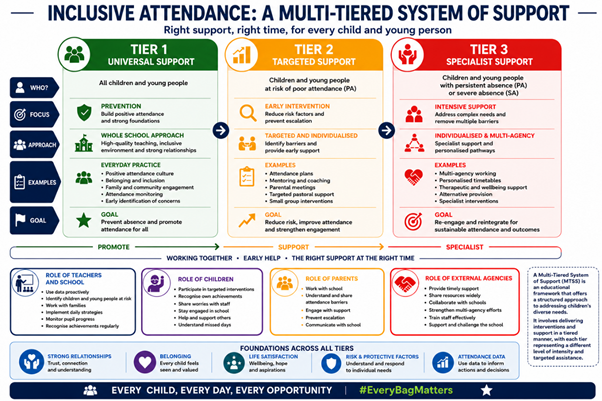
Our Multi-Tiered System of Support helps us respond to different needs. We work with families to understand barriers and provide the right level of help.
1. Support for everyone
A welcoming school, positive relationships, engaging lessons and clear routines help children attend regularly and feel that they belong.
2. Targeted support
When difficulties emerge, we talk with the child and family, agree practical support and review whether it is helping.
3. Specialist support
Where needs are more complex, we work with families, attendance services, the local authority and other professionals to coordinate support.
Support takes account of each child’s circumstances, including health, SEND and wellbeing. We use attendance information alongside what children and families tell us.
Staff training and professional development
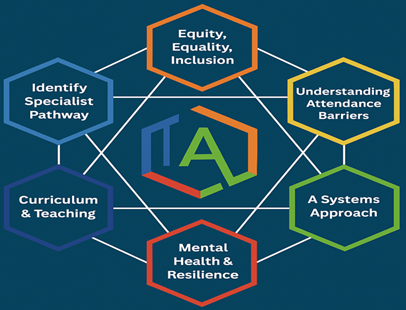
The Inclusive Attendance Professional Development Model guides our staff training. Its six learning modules and four domains of practice bring together professional learning, professional development, evidence-informed practice, and leadership and management.
Ongoing training helps staff recognise barriers to attendance, understand their responsibilities and respond consistently. This includes the links between attendance, mental health, inclusion, the curriculum and safeguarding.
Reviewing and improving our approach
Through the Inclusive Attendance implementation programme, we review our practice and identify improvements as part of our school improvement work.
We monitor attendance regularly, look for emerging patterns and review the difference that support is making for individual children and groups. Plans are adjusted when barriers remain.
We work with CSAWS, the local authority and other services, and learn from practice in other schools. This helps us develop a consistent approach and coordinate support for families.
Why regular attendance matters
Being in school regularly gives children opportunities to:
- Build knowledge and practise skills as their learning develops.
- Develop friendships and stay connected to their class.
- Build confidence through familiar routines and relationships.
- Take part in the wider life of school, including visits, workshops and celebrations.
When children miss school, we want to understand why and help them return successfully. We recognise that some children need additional support to attend.
Recognising attendance
Our recognition-based approach celebrates personal and class achievements, including improvements in attendance. We want children to feel encouraged, included and pleased with their progress.
- Golden Stamp system: recognising attendance, punctuality and readiness for learning.
- Weekly recognition: attendance achievements are celebrated in our Friday Gifts from God assembly, including the class with the highest attendance.
- Class prize boxes: teachers can also nominate their class when there is progress to celebrate. Recognised classes choose a prize box.
We take children’s individual circumstances into account and support those who face barriers to attending. Recognition sits alongside our work with families to understand and address difficulties.
Attendance policy and guidance
Attendance policy 2026–27 (PDF)
Summary of attendance responsibilities (PDF)
Working together to improve school attendance
Please contact the school office if you need a paper copy or help accessing this information.
Our Lady's Catholic Primary School is proudly recognised as an Inclusive Attendance school. Our unwavering commitment to attendance centres around child-centric actions, evidence-informed practices, and a shared understanding of everyone's roles and collective responsibilities to promote exceptional attendance.
At Our Lady's, we are driven by an unwavering commitment to making school attendance a top priority, fully integrated with every aspect of school improvement. Using the Inclusive Attendance Model – the first and only accredited programme providing the pedagogy of practice – we support children and families to connect, belong, and thrive.
Inclusive Attendance Professional Development Model
The Inclusive Attendance professional development model fundamentally guides our attendance approach. Comprising six tailored Learning Modules, this model empowers us to deepen our understanding by facilitating continuous professional learning for all staff. Within this model, the four domains of practice ensure the provision of professional learning, professional development, evidence-based practices, and exemplary leadership and management seamlessly integrate theory into practice.
What To Do if Your Child is Absent from School
Please phone on the first day of absence leaving your child's name, class and reason for absence. This needs to be done every day that your child is absent from school. These messages may be left on the school's answer phone, or delivered in person.
If we have not heard from a parent by 9.30am as to why their child is absent from school, we will ring all of the contact numbers registered for that child until contact is made.
Medical Appointments
If possible, please advise the office beforehand if children have to attend a medical appointment during school hours. Please sign them in and out of school at the main office.
Leave of Absence during Term Time
Parents are requested not to take their children on holiday during term time and holidays taken during term time are classed as unauthorised unless prior authorisation has been granted by the Headteacher.
The school may legally authorise a request for leave where there are 'exceptional circumstances' only. Please contact the office for further information.
Inclusive Attendance Implementation Programme
Each year Our Lady's reviews and further enhances attendance practices through dedicated participation in the Inclusive Attendance 7-month implementation programme. This investment allows us to remain at the forefront of educational change and extends unparalleled support to our children and their families, equipping them with access to the finest possible support.
Impact and Collaboration
Through our ongoing year-long implementation programme, and five year long-term strategy, we deliver measurable impact by creating an inclusive attendance culture and improving outcomes for all children and young people. We are outward-facing in our approach and value working regionally and nationally, through a systems-led model with other schools and external agencies. We continually strengthen and enhance our offer year on year. This work is underpinned by ongoing accredited CPD for staff each year, ensuring sustainable change, stronger outcomes for children and young people, and a deeply embedded culture of collective responsibility.
Multi-Tiered System of Support
To guarantee a comprehensive approach to attendance, we implement a Multi-Tiered System of Support. A Multi-Tiered System of Support (MTSS) for school attendance involves three tiers of intervention, with roles for teachers, the school, children, parents, and external agencies – including the Local Authority. Data-driven decision-making and training requirements are pivotal to the implementation of the system. The system aligns with the Department for Education's (DFE) "Working Together to Improve School Attendance" guidelines.
Recognition-Based Approach
Our attendance philosophy is rooted in a recognition-based approach that recognises both personal and collective achievements. This approach serves to thwart isolation, prevent victimisation, cultivate positive environments, nurture relationships, foster inclusivity, and ultimately cultivate intrinsic motivation among our children, families, and staff. Each week the class with the highest attendance is recognised. As well as this, the class teachers can nominate their class for attendance recognition if they have reason to celebrate – these classes will then get to pick a prize box and the contents is theirs!
The Importance of School Attendance
School attendance is not merely a requirement but a fundamental pillar of education. It plays a pivotal role in shaping academic success, personal growth, and future prospects, making it an indispensable aspect of any educational system. Select the important factors below and remove any that do not relate.
- Academic Achievement: Regular attendance directly correlates with academic success. Children who attend school consistently are more likely to keep up with the curriculum, perform better in exams, and improve their life outcomes.
- Knowledge Acquisition: School is where children acquire knowledge and skills that are crucial for their personal and professional growth. Missing days means missing out on valuable learning opportunities.
- Social Development: School provides a vital social environment for children and adolescents to interact with peers, develop friendships, and learn essential social skills. Consistent attendance ensures children remain connected to their peer group.
- Building Routine: School attendance establishes a structured routine in children’s lives, teaching them time management and responsibility, which are valuable life skills.
- Teacher Interaction: Regular attendance allows for meaningful teacherchild interactions. Teachers can provide personalised support, address questions, and assess individual progress more effectively when children attend regularly.
- Preventing Knowledge Gaps: Frequent absences can lead to significant knowledge gaps, making it challenging for children to catch up with missed lessons, potentially resulting in longterm academic struggles.
- School Engagement: Children who attend school regularly are more likely to engage in extracurricular activities, sports, and other enriching experiences that contribute to their overall development.
- Legal and Parental Responsibility: Parents or guardians are legally responsible for ensuring their child's regular school attendance. Failing to do so can lead to legal consequences.
- Community Wellbeing: High levels of school attendance contribute to the overall wellbeing of communities.
The Impact of Non-Attendance
We cannot stress enough how vitally important good attendance is in ensuring your child makes good progress. If they are regularly late or missing days on a regular basis, this leads to the child falling behind in their learning.
| Days of Education | Attendance | Status | Note |
|---|---|---|---|
| 190 school days | 100% | Good | Gives your child the best chance of success and gets them off to a flying start. |
| 180 school days = 10 days absence |
95% | ||
| 171 school days = 19 days absence |
90% | Worrying | Less chance of success. Makes it harder to make progress. |
| 161 school days = 29 days absence (half a term missed) |
85% | Persistent absentee. Serious concern. |
Not fair on your child. Their learning and progress is seriously affected. Could lead to court action. |
| 152 school days = 38 days absence |
80% | ||
| 143 school days = 47 days absence |
75% |